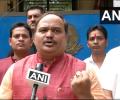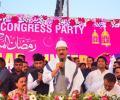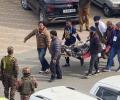
The situation in Muslim-dominated Murshidabad district of West Bengal, which was marred by incidents of violence following protests over the Waqf (Amendment) Act, was calm and peaceful on Wednesday with no reports of any untoward incident. Prohibitory orders were clamped in and around Raghunathganj and Suti police station areas and large police force deployed in all sensitive areas of the district, especially in and around Jangipur town, where a large number of people had assembled on Tuesday afternoon, demanding the withdrawal of the legislation. Internet connectivity remained suspended within the areas under the Jangipur sub-division to prevent the spread of any disinformation. Protestors, who had gathered in large numbers on the NH-12 in the Jangipur area to protest against the Waqf Bill, hurled stones at the police who were deployed in the area, on Tuesday afternoon. A couple of vehicles belonging to the police were allegedly torched during the protest and police had to resort to lathi-charge and use tear gas shells to bring the situation under control. A few policemen were injured in the stone pelting. Police have also detained a few people in connection with the incident. West Bengal Governor C V Ananda Bose condemned the incident and said attempts to disturb the law and order situation in the state "should be put down with an iron hand". The opposition BJP alleged that the law and order situation in the state was "crumbling" under Chief Minister Mamata Banerjee, who was busy with "minority appeasement". The Waqf (Amendment) Bill was passed by the Lok Sabha on Thursday, and by the Rajya Sabha in the early hours of Friday after marathon debates in both Houses of Parliament. The Act aims to streamline the management of Waqf properties (assets permanently donated by Muslims for religious or charitable purposes) with provisions to safeguard heritage sites and promote social welfare. It also seeks to improve governance by enhancing transparency in property management, streamlining coordination between Waqf boards and local authorities and protecting stakeholders' rights.
Kharge claimed that the Centre accepted "intelligence failure" in an all-party meeting and said it should be held accountable for "not reinforcing" security arrangements in Kashmir to protect people.
The editorial came amidst the ongoing tussle between Arlekar and the Marxist party-led Left Democratic Front government over the usage of 'Bharat Mata portrait' during official functions being held in Raj Bhavan.
The chargesheet, which was submitted in court last week, includes views of the premier VJTI, as well as IMD about the ill-fated structure being of sub standard quality and not having the capability to withstand winds, an official said.
The Calcutta High Court has ordered the formation of a three-member committee to identify and rehabilitate people displaced by violence during protests over the Waqf (Amendment) Act in Murshidabad district. The court also extended the deployment of Central Armed Police Force (CAPF) in the area. The committee will consist of officials from the National Human Rights Commission (NHRC), West Bengal Human Rights Commission (WBHRC), and the State Legal Services Authority (SLSA). It will be responsible for identifying displaced persons, assessing damage to properties, collecting FIR data, facilitating FIR filing, and overseeing the well-being of displaced individuals. The state government has been instructed to provide necessary infrastructure to the committee and report on its progress by May 15. The court also directed the state to formulate a rehabilitation scheme for displaced persons, including the construction of damaged houses and shops, compensation for lost livelihoods, and protection for families of those who died in the violence.
Six years after it came to light, all nine men arrested in the sensational Pollachi sexual assault and extortion case were convicted and sentenced to "life imprisonment till death" by a Mahila Court here on Tuesday.
Salian visited the office of the joint commissioner of police (crime) in south Mumbai accompanied by his lawyer, days after he moved the Bombay high court seeking a fresh probe into the circumstances surrounding the death of his daughter and former manager of actor Sushant Rajput in June 2020.
Two petitions have been filed in the Supreme Court seeking a court-monitored probe into the violence in West Bengal over the newly-enacted Waqf (Amendment) Act. The petitions call for a special investigation team or a judicial enquiry commission to investigate the incidents, which have resulted in deaths and displacement. The Calcutta High Court has already ordered the deployment of central forces in the violence-hit Murshidabad district.
Amidst growing calls for the removal of Aurangzeb's tomb at Khultabad in Maharashtra's Chhatrapati Sambhajinagar district, the administration has declared the area a 'no drone zone' and deployed additional security forces. The move comes after demonstrations and online posts demanding the tomb's removal, with some of these posts leading to violence in Nagpur. Authorities are actively monitoring and removing provocative content from social media platforms.
'What does Indira Gandhi want from me? At this age, what will I do to her?'
Protests against the Waqf Act turned violent in parts of West Bengal on Friday, with demonstrators setting ablaze vehicles, disrupting traffic and rail movement, and injuring several policemen. The unrest erupted in Suti, Murshidabad district, where protesters defied prohibitory orders, hurled stones at security personnel, and torched police vans and public buses during processions. Police responded with lathi charges and tear gas, while some officers were forced to seek refuge in a nearby mosque. Similar protests were held in Malda and Kolkata, prompting Governor C V Ananda Bose to direct the state government to take swift action against those responsible. The governor also contacted Union Home Minister Amit Shah and held discussions with Chief Minister Mamata Banerjee. The Waqf (Amendment) Bill, which was recently passed by both houses of Parliament, aims to improve the management of Waqf properties, safeguarding heritage sites and promoting social welfare.
The casualties were reported hours before India and Pakistan agreed to end hostilities, which soared after the Indian Armed Forces hit terror launchpads in Pakistan and Pakistan-occupied Kashmir earlier this week in response to the Pahalgam attack.
The order came following a petition in the high court seeking direction to the police to ensure protection to Opposition party workers in the wake of alleged post-poll violence in some places of the state following the elections.
Supporters of the Indian Secular Front (ISF) clashed with police in West Bengal on Monday during protests against the Waqf (Amendment) Act, leading to several injuries and the torching of multiple police vehicles. The clash occurred after police stopped ISF supporters from attending an anti-Waqf Act rally in Kolkata. The protests escalated when the crowd attempted to break through police barricades. The situation was brought under control after a large police force was deployed. ISF leader Naushad Siddique condemned the Waqf Act and accused the BJP of trying to incite communal tension. Meanwhile, the ruling Trinamool Congress dismissed the ISF as a "party of no consequence." Communal violence related to the Waqf Act has also occurred in other parts of West Bengal.
A bench of Justices Bela M Trivedi and Satish Chandra Sharma issued notices to the Kerala government and the victim in the case and sought their replies within two weeks.
Over two dozen people have been detained for questioning in connection with the suspected bid to derail the Kalindi Express in Kanpur two days ago, officials said on Wednesday.
Tamil actor Ajith condemned the Pahalgam terror attack, expressing his heartbreak and offering prayers for the families of the victims.
The Central Reserve Police Force (CRPF) has announced the formation of a special CoBRA battalion for counter-terrorist operations in Jammu and Kashmir. This decision comes 17 years after the jungle warfare unit was established to combat Naxal insurgency. The new battalion, directed by Union Home Minister Amit Shah, will be deployed in forested areas of Jammu and Kashmir, including the Jammu region, where recent terrorist incidents have occurred. CoBRA units are known for their specialized jungle warfare and guerilla tactics training, and the new battalion will be equipped with modern weaponry, communication, and surveillance equipment.
Protesters in West Bengal's Murshidabad district set fire to police vehicles and hurled stones during a demonstration against the Waqf (Amendment) Act. The incident occurred on Tuesday afternoon in the Jangipur area, where a large crowd had gathered demanding the withdrawal of the legislation. Police responded with lathi charges and tear gas to control the situation. Several people were detained and police personnel were injured in the stone-pelting. The West Bengal Police has said the situation is under control and strict action will be taken against those who resorted to violence.
The Manipur police dismissed the claims of Lt Gen PC Nair, a retired DG of Assam Rifles, in a recent media interview that no drones or rockets have been used in the attacks.
The Supreme Court on Friday said it cannot go by sentiments and has to act in accordance with law, as it refused to entertain a petition seeking contempt action for alleged non-compliance with the apex court's order on protection of properties of people displaced during the Manipur violence.
The Punjab and Haryana high court has directed the Chandigarh police to provide protection for a week to a businessman and his family after he filed a petition alleging threats from Bharatiya Janata Party member of Parliament Kirron Kher and her aide.
The Supreme Court on Thursday criticised Kolkata Police for their 'extremely disturbing' delay in registering the case of a woman doctor who was raped and killed at RG Kar Hospital, while also urging the agitating doctors to return to work amid the fourteenth day of disruptions in healthcare services in Bengal's state-run hospitals.
A delegation from the National Commission for Women (NCW) visited a relief camp in Malda, West Bengal, and reported that women were being harassed and threatened by police. The NCW team, led by chairperson Vijaya Rahatkar, met with those displaced by riots in Murshidabad and alleged that the women were being coerced to return home without proper safety measures. The team is scheduled to travel to Murshidabad and Kolkata to continue their investigation.
A division bench of Justices Revati Mohite Dere and Prithviraj Chavan questioned as to how the police, that usually go to any extent to nab an accused, are unable to arrest them in this case.
Railways ramps up project to instal AI-based cameras that can recognise faces.
Zende along with a group of traders met joint commissioner of Police Ranjan Kumar Sharma and apprised him about the calls.
An official said Akshay Shinde, who worked as a cleaner at the school, was being taken to Badlapur from Taloja jail for investigation.
West Bengal Chief Minister Mamata Banerjee on Monday appealed for peaceful protests in the wake of violence that erupted in several parts of the state during protests against the amended Wakf law. She emphasized the importance of respecting the law and urged people not to indulge in non-religious activities in the name of religion.
The freedom of press can not be used to violate a person's 'inherent' right to reputation and investigative journalism does not enjoy any special protection, the Bombay high court has said while asking a journalist to remove online articles and videos targeting a businessman.
For Ali, who hails from Mendhar sub-division near the Line of Control (LoC) in Poonch district, the uniform is more than a job -- it's a calling. He has dedicated nearly half his life in the police force, serving its various wings with distinction and earning multiple commendations for his courage and unwavering commitment to duty.
Giving details of how she silenced three hostile posts resorting to unprovoked firing on her position during Operation Sindoor, she said, "I had three posts falling in my area. I pinned down the people at all three hostile locations. We hit them with every weapon we had. They were forced to flee their posts."
A division bench of Justices Revati Mohite Dere and Prithviraj Chavan will take up the matter for hearing on Thursday.
People along the Line of Control and International Border in the Jammu region continue to live under the shadow of death, with unexploded mortar shells fired by Pakistani troops still embedded in farmlands and residential areas even though hostilities have stopped for nearly a week. IMAGE: Kindly note that this image has been posted for representational purposes only. Photograph: / Rediff.com Despite the May 10 understanding between India and Pakistan, locals describe the border areas as a 'death trap'. Sixty-two-year-old Balvinder Singh, who returned to his home in Pargwal sector on May 14, recounted a narrow escape. "Two shells exploded in our compound, damaging our house. Three more landed on our farmland. We were terrified and told our family to stay away from the fields until the Army could help," Singh told PTI. Army engineers later came to the village and safely defused the unexploded shells, bringing a temporary sense of relief. "Fear is writ large on the faces of people to these death traps in border hamlets", he said. Scenes of destruction are evident rooftops torn apart, broken houses, windows punctured by shrapnel, and carcasses of cattle lying in pools of blood. The acrid smell of gunpowder still lingers in the air. Sardar Gurmeet Singh faced a similar ordeal. His family could not re-enter their home as a live mortar shell had sunk into the compound in a village close to the International Border. "The army's bomb disposal squad removed it after four days, allowing us to finally enter, back home," he said. Indian Army engineers have launched a sweeping clearance operation across border districts, defusing over 80 unexploded shells in the past five days -- including 6 in Pargwal, 19 in Rajouri, 42 in Poonch, and 12 along the IB. "These shells, mostly 120 mm calibre, have a range of 15 to 30 km and pose a serious threat to both civilian and military targets," an Army officer said. "Many of them were fired by Pakistan during recent hostilities." On May 7, the Indian Army launched Operation Sindoor, conducting precision strikes on nine terror hubs in Pakistan and Pakistan-occupied Jammu and Kashmir (PoJK) in response to the April 22 terror attack in Pahalgam that killed 26 people, most of them tourists. The subsequent retaliation by Pakistan pushed the region to the brink of war. From 7 to 10 of May, 27 civilians were killed and over 70 injured in Pakistani shelling in the Jammu region. Farid Din Gujjar, a resident near the border, expressed fear about returning to his fields. "Several shells created deep craters in our paddy land. We cannot resume work until all unexploded ordnance is cleared. It's a death trap," he said. Army units, in coordination with Jammu and Kashmir Police, have evacuated high-risk zones and issued stern warnings to residents not to touch any suspicious objects or unexploded shells. In one major operation, 42 live shells were safely destroyed in the Poonch villages of Jhullas, Salotri, Dharati and Salani. "All safety protocols were followed. The shells posed a serious danger to local lives," an Army spokesperson said, calling the effort a 'continued commitment to protect civilians and restore normalcy'. Poonch saw the vast majority of deaths due to shelling. Security officials said that Pakistan used a mix of mortar shells, armed drones, and missiles during the shelling spree, specifically targeting civilian habitations and border towns in Jammu, Samba, Kathua, Rajouri, and Poonch. As clearance operations continue, the border residents are slowly returning to their homes, but with caution, fear, and lingering uncertainty about shelling that may yet happen in the future.
The Trinamool Congress on Thursday refuted accusations of a police cover-up by the parents of the woman doctor who was allegedly raped and murdered, insisting that a newly surfaced video contradicts their claims by showing the family previously satisfied with the investigation.
The Kerala High Court has quashed a case booked under the POCSO Act against six journalists of Malayalam news channel Asianet for allegedly disclosing the identity of a minor victim of sexual assault in a program on the ill effects of drug abuse. The court said that the channel's intention was not to disclose the victim's identity and that the program was intended to alert the public about the increasing drug abuse among youngsters in Kerala. The court also criticized some media outlets for reporting allegations without proper investigation or inquiry.
An FIR has been lodged against 10 named and 200 unidentified individuals in connection with a clash and stone-pelting incident during a religious procession in Jharkhand's Hazaribag. The clash, involving two communities, broke out over the playing of an objectionable song. Police fired two rounds into the air to control the situation. The incident led to uproarious scenes in the Jharkhand Assembly with BJP MLAs demanding action against the perpetrators.
The Border Security Force (BSF) launched "Operation Sindoor" in retaliation to unprovoked firing and shelling by Pakistani Rangers along the International Border (IB) in Jammu. BSF troops destroyed three terrorist launch pads and targeted 76 Pakistani border outposts and 42 forward defence locations. The BSF action came after Pakistan launched heavy firing and shelling on 60 Indian posts and 49 forward positions, reportedly providing cover for an attempted infiltration by 40-50 terrorists.
Satish Salian, the father of Disha Salian, former manager of actor Sushant Singh Rajput, has filed a petition in the Bombay High Court seeking a fresh probe into her death in 2020. The petition alleges that Disha Salian was brutally raped and murdered and that there was a politically-orchestrated cover-up to protect certain influential persons. The petition names Shiv Sena (UBT) leader Aaditya Thackeray and calls for the probe to be transferred to the CBI. The petition also claims that the Mumbai police hastily closed the case as a suicide or accidental death without considering forensic evidence. Salian's death occurred on June 8, 2020, after she fell from the 14th floor of a residential building. The city police had registered an Accidental Death Report (ADR) case at the time. The case has drawn renewed attention after Rajput's death on June 14, 2020, which was also initially ruled a suicide but was later handed over to the CBI. The petition has sparked reactions from various political figures, with some calling for Thackeray to resign and face the investigation.